Worship
About our Worship
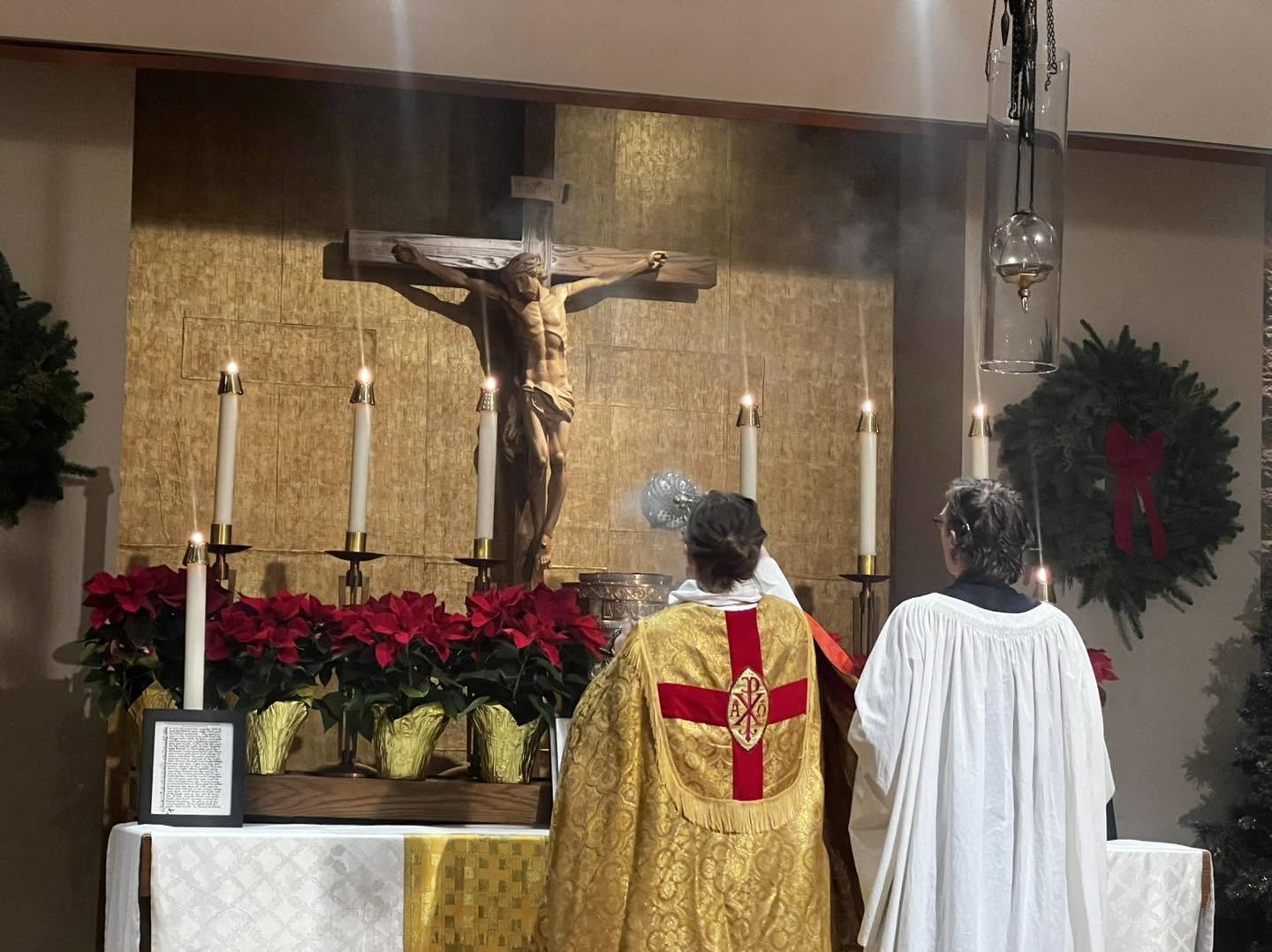
St. Mary’s is a community of faith grounded in the worship of God: Father, Son, and Holy Spirit. Our worship is shaped by the historic rhythms of the Anglo-Catholic tradition in the Episcopal Church, a movement formed from a desire to reclaim the practices and piety of the early church in a world hungering for grace and beauty. The vestments the clergy wear and the symbolism of art and action work together to remind us that we are part of something much greater: the outpouring of love and praise offered by men and women of every tribe, language, people, and nation – a tradition that began long before we were born and will continue long after we have died. This is called "Anglo-Catholic" because it emphasizes the rich Catholic heritage within our Anglican tradition.
The people of St. Mary’s have always believed that worship should involve the whole person: body, mind, and spirit. The incense and bells, the music, the words we sing and speak all embody our desire to love and serve Jesus Christ with our whole heart, soul, mind, and strength.
Each Sunday, St. Mary’s celebrates the Holy Eucharist, or Mass as our primary communal form of worship. From Tuesday to Friday, Morning Prayer is said in the Chapel. All are welcome. Always.
-
Morning Prayer is a simple, said service, approximately 25-30 minutes long, consisting of scripture readings, prayer, and the recitation of selections from the book of Psalms. It is a calm and contemplative way to ground one’s day in the word of God.
-
The Mass, also called Holy Communion or the Eucharist, is the core act of Christian Worship. At Mass, we gather to hear the stories of God’s mighty acts throughout history; pray for the needs of ourselves, our community, and the world; and enter into communion with God through the sacrament of Christ’s Body and Blood.
At St. Mary’s, we believe that the risen and glorified Christ is physically and spiritually present in the form of bread and wine, which are mystically transformed into his Body and Blood. In this way, we are joined to Christians throughout history. Through Holy Communion we are called to receive Jesus into our bodies and souls and take him out into the world as icons of God’s grace and light.
-
Each celebration of the Mass is the full sacrament of the Lord’s Body and Blood, but depending on the circumstance, there may be varying degrees of ceremony involved.
Low Mass is a contemplative spoken service with a priest and possibly a server. The sermon, if there is one, may be improvised.
Sung Mass is a more elaborate form of the Eucharist where the Ordinary of the Mass (the Kyrie, Gloria, Sanctus, and Agnus Dei) and the text of various prayers may be sung, along with hymns. The priest is assisted by servers. Incense is used. At this time, Sung Mass is the most common service offered on Sunday morning.
Solemn Mass is an expanded form of Sung Mass which includes two more sacred ministers, a deacon and a subdeacon. This service is always sung, with hymns and incense.
If the Mass is said (or sung) by the Bishop, it may be referred to as a Pontifical Mass.
-
The tradition of using incense dates back to ancient Hebrew worship (cf. Psalm 141:2). Incense symbolizes the prayers of the faithful rising up to heaven. Incense appears repeatedly throughout the Bible in association with prayer and worship to the Divine, most notably in the books of Isaiah and Revelation.
The smoke of incense is associated with purification and sanctification. Thus, the elements of the Eucharist are censed to show they are set apart, and we cense people to acknowledge they are set apart by their baptism. Incense is another way we engage our senses in worship.
From time to time, St. Mary’s uses seasonal blends to mark various feasts and seasons.
-
At St. Mary’s, we generally sit to hear the Word proclaimed, stand to sing, and kneel to pray. Kneeling during the Eucharistic prayer is a symbol of the particular reverence we hold as part of our Catholic expression of faith.
These bodily movements are yet another way we engage our senses in worship. Yet, we acknowledge that not everyone’s bodies may be able to participate in the “pew calisthenics.” We invite all to participate as they feel comfortable and/or able.
-
Processions are liturgical acts. They are ancient rituals of prayer and petition, and are symbolic of our life’s pilgrimage. There are three primary forms of processions.
On Sundays where there will be a baptism, we begin our worship with a holy water procession, during which the celebrant sprinkles the people, altars, and shrines with Holy Water as a reminder of our baptism.
On major feasts, we make a solemn procession to a particular location in the church, usually the Shrine of Our Lady or the font, where we offer prayers appropriate to the day or season.
In Lent, we sing the Great Litany in procession immediately before Mass as an act of supplication, offering the prayers and concerns of our life to God.
The people are invited to join in both the second and third kind of processions. Other processions may take place from time to time, including processions of the Blessed Sacrament on Maundy Thursday, Christ the King, and Corpus Christi; and the solemn procession of Palm Sunday, where we recount our Lord’s triumphal entry into Jerusalem.
-
The priest’s robes, or vestments, are historic garments that have come to us from the ancient church. As she puts on each item before saying Mass, prayers are said to remind her of the spiritual meaning of each vestment, and to prepare her heart and soul to offer the holy sacrifice of the Mass for the people of St. Mary’s.
The amice, which is a square piece of linen originally intended to protect vestments from sweat and hair oils, is representative of the helmet of salvation (Ephesians 6:17).
The alb, or long, white linen garment worn under the other vestments is a reminder of the baptismal garments Christians historically wore.
The maniple, or short colored band worn at the wrist is a symbol of service and is thought to be derived from a server’s napkin. Another theory holds that it was a cloth worn by priests in the early church to wipe away their tears of joy as they celebrated the Eucharist.
The stole, or long colored band worn crossed around the neck (or diagonally for a deacon), is a symbol of sacramental ministry, and is a reminder of the stole of immortality lost by our first parents, Adam and Eve, in the garden.
Finally, the chasuble, or large poncho-like garment worn over all of the above, is a symbol of the purple robe put on Christ at his passion, and of the yoke of Christ (Matthew 11:28-30).
-
The colors of the vestments and altar hangings tell the story of the church year. The color scheme we use developed over the past 1,000 years and has become universalized in the Western Church in (relatively) recent history.
Green is used for the Season after Pentecost (also known as Ordinary Time), and for regular weekday services during that time. Services on a weekday that do not commemorate a particular feast are known as ferias.
Red is the color associated with Martyrdom and the Holy Spirit. It is most commonly used on Pentecost Sunday, at Ordinations, and during Holy Week.
White is the color of the saints who were not martyred, Holy Baptism, Marriage, Feasts of our Lord, Feasts of St. Mary, Christmas and Easter. It is also used for Funerals in the Episcopal Church.
Blue is used for the season of Advent, the period of preparation before Christmas. The use of Blue for Advent dates to the medieval English church.
Purple is the color of royalty and penance. It is used on Sundays in Lent (the period of preparation before Easter), on Vigils, and for Confession.
Unbleached Linen, or Lenten array is used on Weekdays in Lent, and on Ash Wednesday. It represents the prophets sitting in sackcloth and ashes.
Rose is used twice a year, on the Third Sunday of Advent, and the Fourth Sunday in Lent, which are traditionally associated with a break in the fasting practice.
Black was historically used for funerals, but is currently used at St. Mary’s for our All Souls’ Requiem, and for Requiems associated with the Society of All Souls.
Gold may be used for particularly joyful feasts such as Christmas, Easter, Epiphany, and the Ascension, in place of White.
-
There are two primary sung portions of Mass: the Ordinary and the Propers.
The Ordinary consists of the pieces of the Mass which remain the same each week. They are the Kyrie, Gloria in Excelsis, the Sanctus, and the Agnus Dei.
The Propers are small pieces of the Psalter and other scriptural texts that change week-by-week. They are usually thematically associated with the readings for each week. They are the Introit (also known as the Entrance Chant), the Alleluia (replaced in Lent by the Tract), the Offertory, and the Communion.
The Ordinary and the Propers have been part of traditional Western Christian worship since the early days of the Church, and are taken from scripture. Their inclusion in our worship is another way we connect our worship with the worship of Christians throughout the ages.
-
At St. Mary’s, portions of the service are said facing east, toward the altar (aka ad orientem in fancy church-speak). This position of prayer is older than Christianity itself, and appears throughout world religions. In the Early Church, the Holy Eucharist was celebrated early in the morning, with the rising sun as a symbol of Christ’s resurrection and his future coming in glory.
By facing east, toward the altar, the Priest stands in solidarity with the people, offering the prayers of the people up to God on his throne of Glory in heaven, and our Lord Jesus Christ in the Sacrament of the altar, which is reserved in the tabernacle.
In recent years, some sections of the church have argued that ad orientem turns the service into a performance, or is the priest snubbing the people. Nothing could be farther from the truth. Imagine a guide on a trail: the priest faces forward because she is guiding the people to a shared destination, not because she is ignoring them. The priest and people face God, together, as they enter into the divine mystery of the Holy Eucharist.
-
The Anglo-Catholic movement has been associated with a concern for social issues from its very origins. Generations of Anglo-Catholics have been taught that Catholic faith and practice are not only compatible with caring for the poor and disenfranchised, but that one flows directly from the other.
Beauty is reflective of God, just as humanity, made in the image of God is reflective of God. All people, no matter their social standing, race, gender identity, sexuality, nationality, or other category have value, are worthy of beauty, dignity in work, education, living wages, and healthcare. All people deserve to be treated with dignity and respect. All people deserve to experience God in the beauty of holiness when they gather to worship and recieve the Holy Sacrament of the Altar that sends them back into the world as the hands and feet of Christ.